

“The compulsion which we must use towards our enemy will be regulated by the proportions of our own and his political demands.”
— Carl von Clausewitz, On War, Book VIII, Chapter 3.
“Two or more whole machines can be coupled to form one machine”
— W. Ross Ashby, An Introduction to Cybernetics, §4/6.
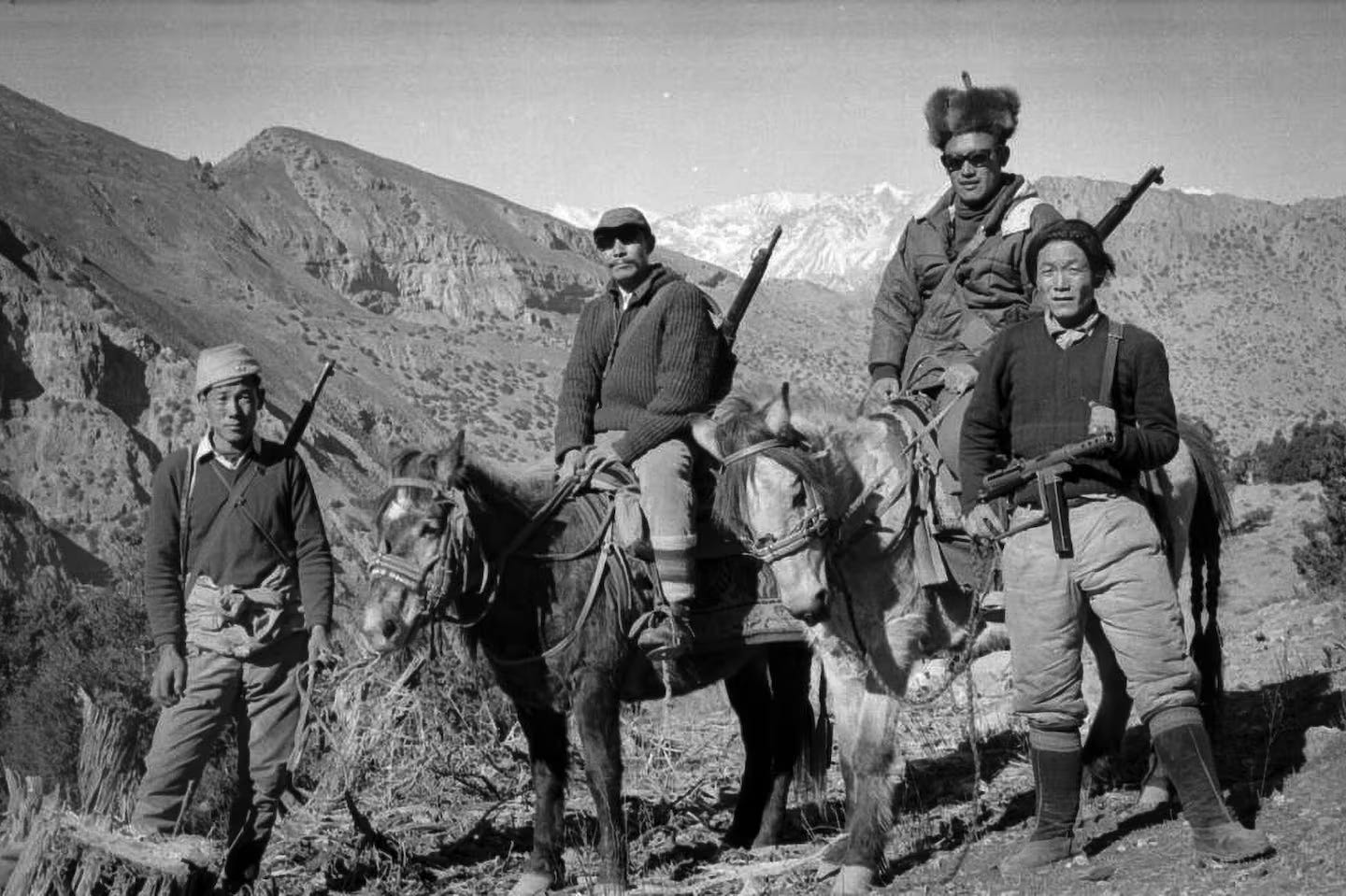
In October 1961, thirty Tibetan fighters slipped out of Mustang, a remote Himalayan region in Nepal, and crossed into Chinese-held Tibet. They ambushed a People’s Liberation Army convoy and returned with a commander’s pouch containing more than 1,600 classified documents. The documents exposed problems within the Chinese army and Communist Party and provided the first hard evidence of the famine caused by Mao’s Great Leap Forward. CIA officials called it the best intelligence coup since the Korean War.
Thirty men could not threaten Beijing, and no one expected them to. They were part of a campaign meant to weaken Chinese control, keep the idea of an autonomous Tibet alive, and gain insight into a closed country. Measured against that purpose, the raid was a success.
Propose American backing for a foreign resistance at a modern planning table, and the concept rarely survives the first hour. The conversation immediately pivots to whether the irregular partner can topple the government, who will govern afterward, and whether American advisors can survive the deployment. These valid questions have hardened into a bureaucratic default that strips unconventional warfare from the policy menu before planners assess what the capability could achieve.
The historical case of Tibet, alongside the recent debate over the potential use of Iran’s Kurds, exposes three half-truths behind this default. Each rests on an incomplete reading of the doctrinal definition, turning a legitimate operational concern into a reason to rule out the option entirely. Because each contains a grain of truth, the resulting bias is easy to miss.
The Case Against UW
The first objection centers on the day after. Covert regime change has a poor track record. Political scientist Lindsey O’Rourke examined sixty-four covert U.S. regime-change attempts between 1947 and 1989. Only 39 percent replaced the targeted leader in the short term, and those targeted states were subsequently more likely to suffer civil war or mass killing. Any planner familiar with that history has every reason to ask who governs once the old regime falls.
The second concerns the partner. The Iranian Kurdish groups that American and Israeli planners looked to in March 2026 were small, divided, and outgunned. The Times of Israel acknowledged that a limited offensive could draw Iranian troops to the border, while its headline emphasized that “Kurdish rebels won’t be the ones bringing down Iran’s regime.” Denise Natali described lightly armed fighters lacking armor and air defense and judged them “not a cohesive fighting force.” Mark Grdovic, one of my mentors, served alongside Iraq’s Kurdish resistance in 2003 and wrote the history of that campaign in Those Who Face Death. He identifies what any serious assessment must examine: political compatibility, leadership, government control, terrain, and population cohesion. A partner that fails those tests is a bad bet.
The third objection centers on force protection and political risk. Critics argue that the modern security environment makes UW infeasible because American Special Forces teams would be hard-pressed to sustain long-term operations in places like Iran, and the political cost of casualties is too high. I concede part of this. In a recent article, I detailed how ubiquitous surveillance and a lack of rural safe areas make infiltration and sustainment prohibitively difficult for operators carrying American biometrics into megacities like Shenzhen. From there, however, conventional planning makes a fatal assumption: if U.S. advisers cannot physically deploy and sustain themselves on the ground, UW is not an option.
All three objections raise valid concerns. Any one of them might be reason enough to scrap a specific plan. But using them to rule out unconventional warfare altogether stems from a fundamental misreading of the doctrine.
The Doctrinal Blind Spot
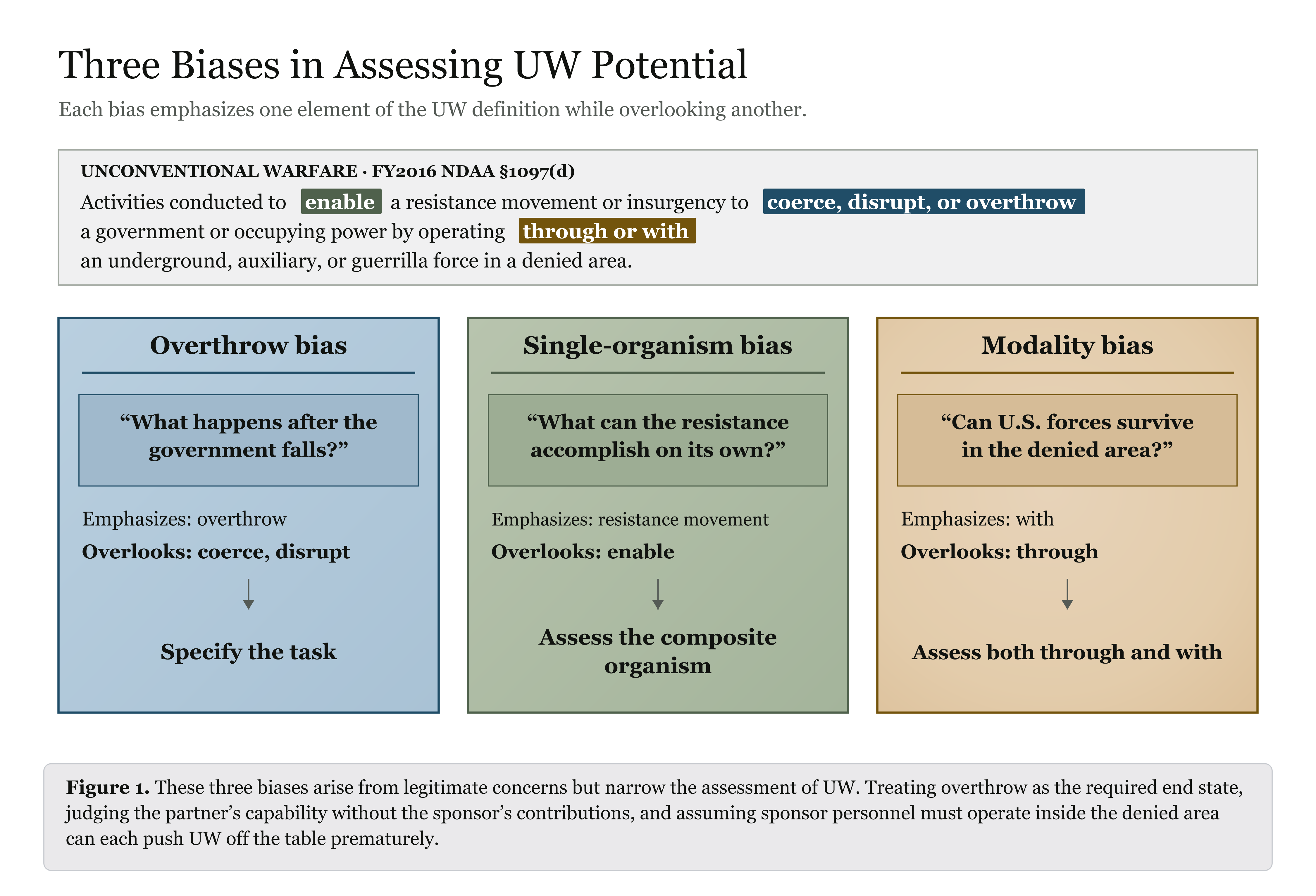
The FY2016 National Defense Authorization Act defines unconventional warfare as “activities conducted to enable a resistance movement or insurgency to coerce, disrupt, or overthrow a government or occupying power by operating through or with an underground, auxiliary, or guerrilla force in a denied area.”
Planners worried about the day after fixate on overthrow and ignore the options to coerce and disrupt. Those evaluating the partner fixate on the existing resistance movement while ignoring the sponsor’s mandate to enable it. Planners concerned with survivability assume advisors must operate with a resistance and ignore the provision to operate through one.
The last two reinforce each other. One treats the sponsor’s physical presence as indispensable; the other measures the partner’s capability in isolation. Together, they obscure the possibility of a sponsor enabling the partner from outside the denied area.
These are overthrow bias, single-organism bias, and modality bias.
In our 2012 Naval Postgraduate School thesis, Why UW, Colonel Ryan C. Agee and I screened more than fifty historical cases and selected four (Iran, Tibet, Laos, and Nicaragua) to identify patterns that held across strategic environments. An existing UW capability was one of three conditions present at the decision to act, and in every case it existed before the decision was made. But possessing a capability is not the same as possessing a valid one. A valid capability can accomplish a specified task. Each bias distorts that judgment.
Overthrow Bias: The Regime Change Trap
Overthrow is one of UW’s three doctrinal purposes, not a universal requirement. Yet professional military discourse repeatedly defaults to it as the standard. Otto Fiala and Jim Worrall identified this imbalance in 2021, noting that UW discussions concentrate on overthrow while giving coercion and disruption little attention. A 2024 Military Review article illustrates the problem, describing Special Forces training in terms of overthrowing governments and assessing its utility through regime-change outcomes.
When regime change becomes the default test, every other capability looks like a failure. A force suited for localized disruption is discarded because it cannot deliver a national political transformation. The task is enlarged before the capability is ever measured.
In the same issue of Military Review, retired Lieutenant General Ken Tovo, a former commander of U.S. Army Special Operations Command, alongside co-authors Kyle Atwell and Anthony Marco, explained how a resistance can shape a conventional campaign. An irregular partner can tie down enemy troops, impose costs, and generate intelligence without winning the war on its own. That is the limited, practical task that overthrow bias filters out. The Kurdish debate turned on exactly this distinction: border pressure that pulls Iranian troops to the frontier is a different task from an offensive that brings down the regime.
Mark Grdovic acknowledges coercion and disruption as legitimate purposes. The problem lies in how planners apply his criteria. Terrain suitable for sustained guerrilla warfare matters when guerrilla operations are proposed; it is not a requirement for clandestine underground work. A partner’s suitability to govern a successor state is central to regime replacement; it is not a prerequisite for a disruption task. Assessment criteria must scale to the specific operational task.
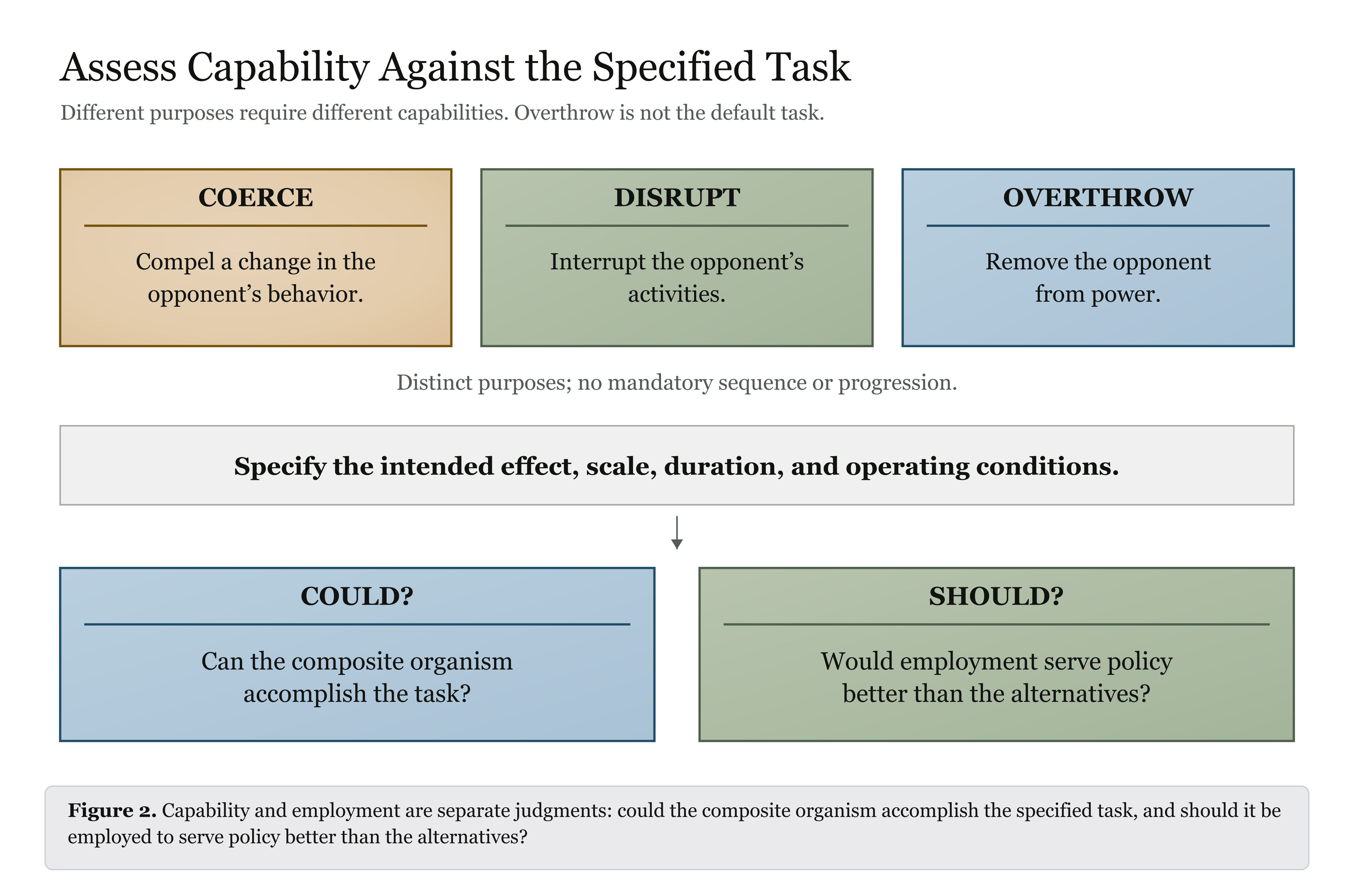
No one assesses a bomb by its ability to overthrow a government. Planners ask what effect it can produce against a target, then whether that effect serves policy. Sponsored resistance requires the same distinction. Proving that a capability can execute a task does not prove that employing it is wise.
That second judgment is where the aftermath objection belongs. What would disruption contribute? How might the adversary respond? A limited purpose does not guarantee limited escalation. O’Rourke’s record warns against the perils of overthrow; it does not measure what sponsored resistance achieves through coercion or disruption. No one asks the bomb to govern.
Single-Organism Bias: Measuring the Partner in Isolation
The capability objection demands that a prospective partner already possess the capabilities that sponsorship is meant to build. If the partner already had them, U.S. sponsorship would be unnecessary.
In “Visible vs. Valuable,” I termed the alternative the composite organism: the operational entity created when a sponsor and an irregular partner combine their complementary strengths. The partner brings local knowledge, access, relationships, and motivation. The sponsor brings resources, technical expertise, and organizational capacity. What connects them is the Golden Bridge, the working relationship built through training, advising, assisting, and enabling.
The British cybernetician W. Ross Ashby’s work on coupled systems explains the underlying mechanics: the behavior of a joined system depends on its parts and on how they connect. Therefore, the joined system, not the isolated partner, must be the primary unit of assessment. But this bridge must hold up in practice. Sponsor resources are useless if the authorities, communications, and logistics do not exist to deliver them on time.
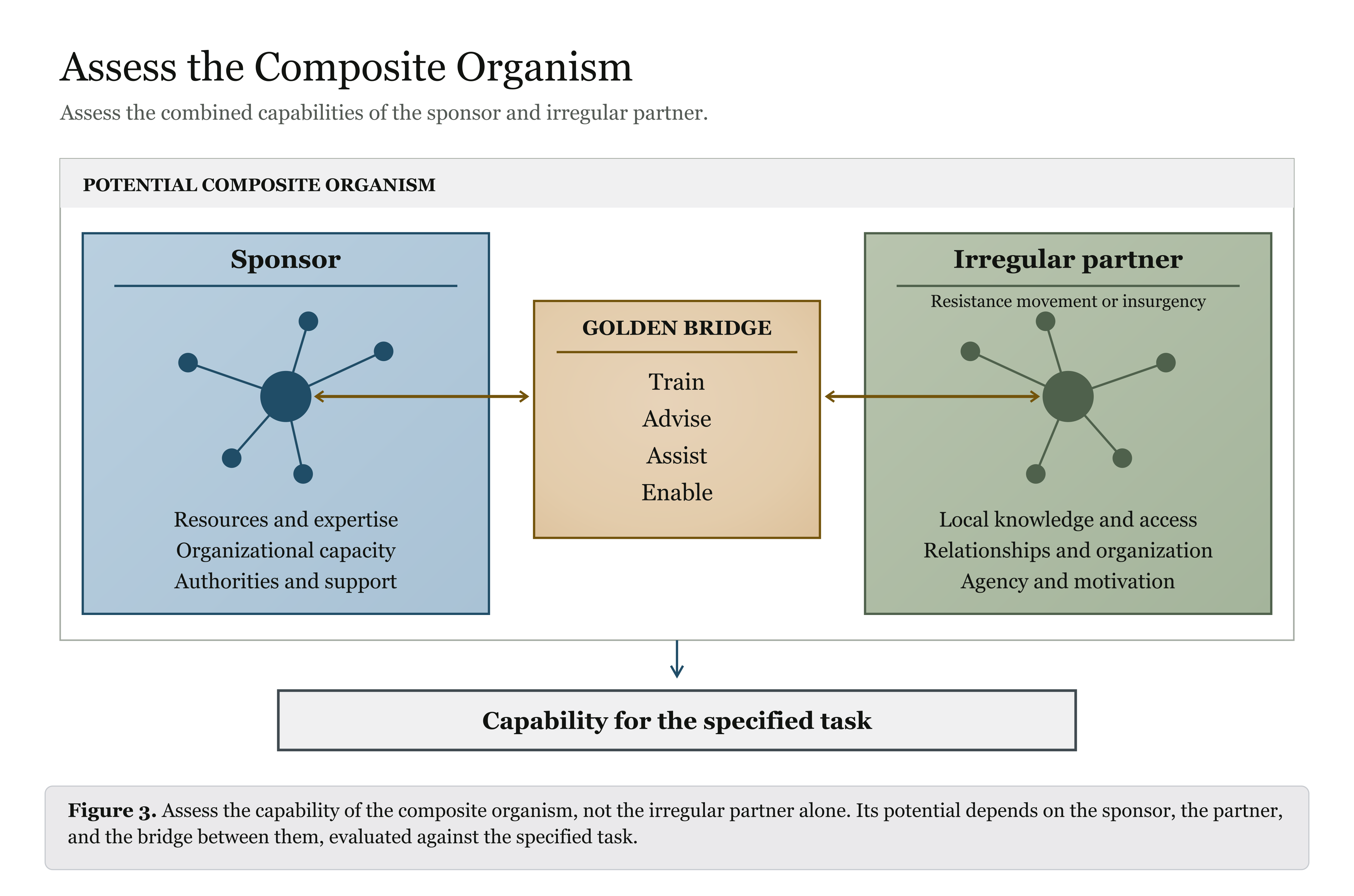
Jonathan Schroden and Zack Gold, researchers at the nonprofit CNA, assessed the Kurdish groups this way. They judged them too small and fragmented to seize and hold territory alone, then asked what U.S. “weapons, funding, training, intelligence, and air support” could add. Their answer, potential for “localized pressure on Iranian security forces,” measured sponsored capability against a limited task. That is how I would extend Grdovic’s framework: assess the sponsor and the Golden Bridge as explicitly as the partner.
By early April 2026, the anticipated Kurdish offensive had not materialized. On March 7, President Trump said, “I don’t want the Kurds going in.” A Komala commander reported no serious official foreign support for arming his fighters; another party cited the danger of retaliation against Iraq’s Kurdistan Region. Perceived partner capability gaps explained part of the outcome. Sponsor decisions and constraints on the Golden Bridge explained the rest.
Planners assess an infantry battalion with its fires, aviation, and logistics. They routinely assess a resistance movement without its sponsor.
None of this makes partnership simple. As the proxy warfare theorist Amos Fox argues, partners’ interests and relative power can drift apart over time. A composite organism is a working arrangement, not a merger of interests, and its cohesion and durability have to be assessed, not assumed. Principal-agent theory examines delegation and those divergent interests. The composite organism adds a capability question: what can sponsor and partner accomplish together that neither can accomplish alone?
Modality Bias: The Fixation on With
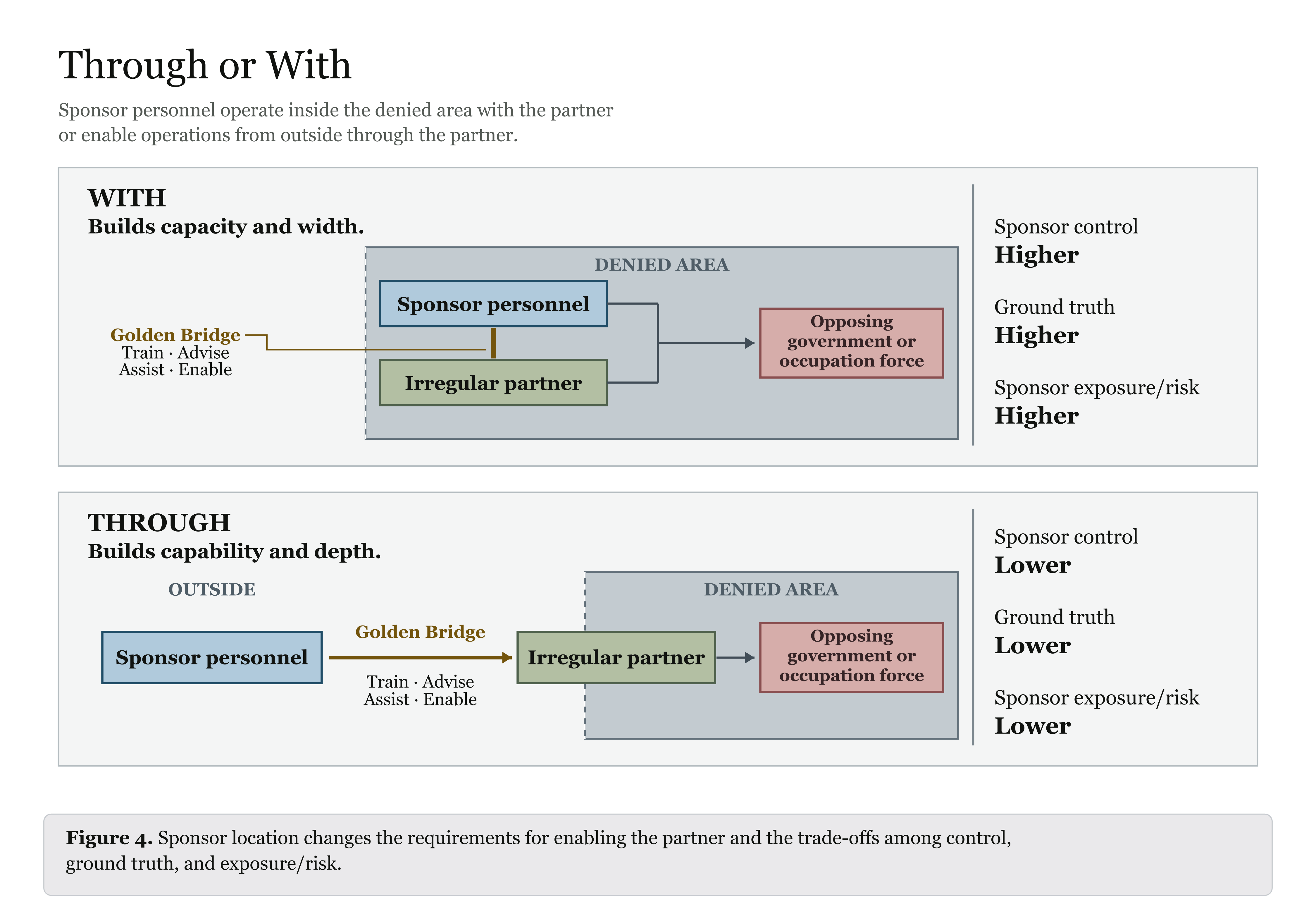
Working with a partner places sponsor personnel alongside the irregular force inside the denied area. Working through a partner keeps sponsor personnel outside, sending training, resources, intelligence, and operational direction across the boundary.
The with model builds capacity and width through fighters trained and led side by side. The through model builds capability and depth, allowing the partner to carry support into areas foreign personnel cannot enter.
That choice shapes the mission architecture. Staffing, communications, logistics, and the Golden Bridge must fit the modality. Working with a partner trades security and risk mitigation for ground understanding and tactical control. Working through reverses that trade. Both can build a capable composite organism, but planners must design the difference in from the start.
The objection that Americans cannot survive inside the denied area applies only to the with modality. The through model relies instead on secure access to the partner, a viable route across the boundary, and a partner capable of acting on the support received. My concession about Shenzhen stands. The conclusion drawn from it does not. A Special Forces team that cannot survive inside a denied area can still enable a partner who already lives there.
The 1980s Afghan campaign operated largely through this second model. The presidential finding authorizing the program directed the CIA to work through Pakistan and defer to Pakistani priorities. Pakistan’s intelligence service trained the mujahideen and moved weapons across the border. The Soviet army withdrew in 1989, an outcome captured by the title of Bruce Riedel’s history of the program: What We Won.
Afghanistan is also an example of the potential risks. Pakistan decided which factions received support, directing the vast majority of funding to Islamist parties. Washington gained military pressure against the Soviets while surrendering control over the partners and the political outcome. Those risks should be captured in any assessment. However, they should not automatically remove the option of UW from consideration.
Answering All Three
Which brings the argument back to Mustang. The American-supported Tibetan resistance, run under the code name ST CIRCUS, is one of the most important and least studied cases of U.S. unconventional warfare. Beginning in 1956, the CIA and military advisors trained Tibetans abroad, roughly 250 to 300 of them at Camp Hale in Colorado between 1958 and 1964, and infiltrated them back into Tibet. Operations from Mustang continued until 1974.
The campaign answers overthrow bias first. American objectives, as recorded at the time, included weakening Chinese capabilities and influence, sustaining the prospect of an autonomous Tibet, and maintaining a capacity for resistance. Tibetan hopes for liberation were related but politically distinct. Toppling China’s government was never the measure of American success.
It answers single-organism bias next, because the resistance’s capability was a composite organism. Camp Hale graduates formed an elite cadre inside a much larger resistance, and a parallel air program, ST BARNUM, dropped the weapons and supplies that let them train more fighters. The 1961 convoy raid required both halves: Tibetan fighters captured the documents, and American analysts made them a staple of U.S. intelligence on the Chinese army.
The campaign also answers modality bias. The sponsor operated through the partner. No American had to survive inside Tibet to produce that effect.
That model did not eliminate constraints. At the March 1968 review, a CIA representative judged achievements inside Tibet as minimal, with outside efforts more substantial. The status report described pervasive Chinese security, uncovered and neutralized underground assets, resupply difficulties, and restrictions on offensive action to avoid retaliation. Sponsor tolerance for risk was one constraint among several.
Outside Tibet, the program sustained political organization and international visibility through lobbying at the United Nations, refugee support, and an active press. Those activities supported the campaign’s coercive purpose beyond the reach of its guerrillas.
The program did not end in battlefield defeat. Washington approved a gradual phase-out in 1969, and U.S. support for the Mustang force ended in fiscal year 1974.
Disruption and coercion, not overthrow. Sponsor plus partner, not the partner alone. Through, not with.
Why Not UW
Unconventional warfare deserves its place on the menu of strategic policy options when a potential composite organism can accomplish a specified task, through or with a partner, at an acceptable level of risk. Possessing a valid capability is never an obligation to use it.
These three biases are not the only reasons UW gets set aside, and sometimes setting it aside is the right call. Policy, timing, the partner itself, or other constraints may rule it out. The three examined here do something different: they declare the option unavailable before it is assessed.
Five questions provide a better test. The first four ask whether UW could work. The fifth asks whether it should.
1. The task. What effect must the irregular partner produce (coercion, disruption, or overthrow), and against which adversary vulnerability?
2. The gap. What are the proposed partner’s current capabilities to complete that specific task, and what is missing?
3. The bridge. What can the sponsor provide (train, advise, assist, enable) to close the gap and build the composite organism, and do the authorities, access, and time exist to deliver them?
4. The modality. Can the sponsor work with the partner, or only through it, and what are the associated risks regarding sponsor exposure, loss of control, and compromised ground truth?
5. The right choice. Would employing this composite organism complement the joint force or serve policy better than the alternatives, once the adversary’s response and the aftermath are considered?
For planners and analysts, these questions give unconventional warfare a fair assessment. For practitioners, they define the work ahead. Decision makers can only choose options that already exist. That means training for coercion and disruption, not only overthrow. It means building the sponsor’s required capabilities to work through a partner from outside, not only with one inside. And it means developing relationships with potential partners long before a crisis. The force that has done that work will have answers when the five questions are asked.
Those answers, not the three biases, should decide whether UW stays on the table. Any evaluation that demands regime change as the sole metric, measures the partner in a vacuum, and assumes U.S. forces must infiltrate the denied area is not an assessment at all. It is a predetermined rejection.
From Why Not to Why
The previous article, “When Is Irregular Warfare… Unconventional?”, ended by asking why UW still matters. From Iran’s Kurds to Ukraine to Taiwan, the question is no longer academic. The next articles turn from “why not” to “why,” examining how relationships, networks, and infrastructure in place before a crisis shape the options available at the decision point.
If this article was helpful and you would like more content like it, please like and subscribe. Comments, questions, and feedback are always welcome.
Sources and further reading
A note on sources. Descriptions of how unconventional warfare is discussed in planning and policy settings draw on the author’s participant observation across more than four decades in U.S. special operations, including UW doctrine work at the U.S. Army John F. Kennedy Special Warfare Center and School and service as Senior Irregular Warfare Advisor at U.S. Special Operations Command.
Ryan C. Agee and Maurice K. DuClos, Why UW: Factoring in the Decision Point for Unconventional Warfare, master’s thesis, Naval Postgraduate School, December 2012. Case selection, pp. 9–23; Tibet, pp. 49–70; analysis and findings, pp. 137–153; recommendations, pp. 157–160. Page references use the thesis’s printed pagination.
W. Ross Ashby, An Introduction to Cybernetics (London: Chapman & Hall, 1956), chapter 4, especially §§4/6–4/8, pp. 48–52.
Lazar Berman, “Small, divided and wary, Kurdish rebels won’t be the ones bringing down Iran’s regime,” Times of Israel, March 15, 2026. The quoted conclusion is the article’s headline.
Central Intelligence Agency, “Spy Sites: Skis, Spies, and America’s Newest National Monument Camp Hale,” March 20, 2023. Training at Camp Hale and the cadre’s subsequent role in training additional Tibetans.
Carl von Clausewitz, On War, Book VIII, Chapter 3, trans. J. J. Graham, 1873, section B. Epigraph wording follows that translation.
Steve Coll, Ghost Wars: The Secret History of the CIA, Afghanistan, and Bin Laden, from the Soviet Invasion to September 10, 2001 (New York: Penguin Press, 2004), p. 58, on the finding’s instruction to work through Pakistan.
Kenneth Conboy and James Morrison, The CIA’s Secret War in Tibet (Lawrence: University Press of Kansas, 2002). Detailed operational history, including ST CIRCUS and ST BARNUM. On the October 1961 raid and the intelligence value of the captured documents, see p. 162.
Maurice “Duc” DuClos, “Operationally Detached: Why Decentralization, Not Consolidation, Is the Future of U.S. Army Special Forces,” Irregular Warfare Initiative, May 28, 2026. See “The Wrong Domain.”
Maurice “Duc” DuClos, “Visible vs. Valuable: Why Restructuring U.S. Special Forces Won’t Fix a Failure of Perception,” Small Wars Journal, June 1, 2026. See “What the Blindness Hides: The Composite Organism.”
Daniel Eerhart, “The Strategic Imperative: USASOC’s Role in Advancing Civil Resistance Movements during Irregular Warfare,” Military Review, November–December 2024. See “Contextualizing the Problem.”
Otto C. Fiala and Jim Worrall, “Imposing Costs: Unconventional Warfare in the Information Environment,” Modern War Institute, July 6, 2021.
Foreign Relations of the United States, 1964–1968, vol. XXX, “Review of Tibetan Operations,” January 9, 1964, document 337; and “Status Report on Tibetan Operations,” 1968, document 342. Contemporary assessments of objectives, activities, resources, and constraints. The CIA representative’s assessment appears in the source note to document 342, recording the 303 Committee discussion of March 19.
Foreign Relations of the United States, 1969–1976, vol. XVII, memorandum from Marshall Green and Joseph Sisco to U. Alexis Johnson, September 6, 1972, document 280. Continued funding, the 1969 phase-out plan, and the end of maintenance for the Nepal-based force in fiscal year 1974.
Amos C. Fox, In Pursuit of a General Theory of Proxy Warfare, Land Warfare Paper 123, Association of the United States Army, February 2019, especially pp. 5–9.
Mark Grdovic, “Understanding the Potential Value and Risks of Arming Indigenous Groups in Support of US National Objectives,” June 14, 2026.
Robert C. Jones, “Setting the Force: 10 Steps for Resolving the Special Forces ‘Identity Crisis,’” Small Wars Journal, October 29, 2025. See “Free unconventional warfare from the burdens of our storied past,” on how emphasizing overthrow and denied areas makes UW easy to reject.
Gilles Kepel, Jihad: The Trail of Political Islam (Cambridge, MA: Harvard University Press, 2002), on the distribution of aid among the Afghan parties.
John Kenneth Knaus, Orphans of the Cold War: America and the Tibetan Struggle for Survival (New York: PublicAffairs, 1999). A participant account by a CIA officer involved in the Tibetan program. On the October 1961 raid, see p. 249.
Ned Marsh, “A New Vision for Special Forces,” Irregular Warfare Initiative, May 20, 2026. See “Mismatch.” The article’s assessment is distinguished here from evidence of an actual government decision.
Denise Natali, “Iranian Kurds Can Fight, but How Effectively?” Foreign Policy, March 17, 2026.
National Defense Authorization Act for Fiscal Year 2016, Public Law 114–92, November 25, 2015, §1097(d), 129 Stat. 1021. The definition applies within that section.
Lindsey A. O’Rourke, Covert Regime Change: America’s Secret Cold War (Ithaca, NY: Cornell University Press, 2018). Figures as summarized in H-Diplo|ISSF Roundtable 13-3, November 5, 2021. Her cases cover covert regime-change attempts of all kinds, not UW alone.
Lizzie Porter and Stella Martany, “Why a ground offensive by Iranian Kurds against the regime never materialised – and why it still could,” The National, April 2, 2026. Quotations from President Trump (March 7), Omed Taheri of Komala, and Jwansher Rifaati of the PAK.
Bruce Riedel, What We Won: America’s Secret War in Afghanistan, 1979–1989 (Washington, DC: Brookings Institution Press, 2014).
Tyler Rodriguez, “The Inevitable Invasion Is Over, Now What? Resistance in a Post-Invasion Taiwan,” Irregular Warfare Initiative, September 3, 2025; originally published in Small Wars Journal, August 18, 2025.
Idean Salehyan, “The Delegation of War to Rebel Organizations,” Journal of Conflict Resolution 54, no. 3 (June 2010): 493–515. A foundational principal-agent treatment of state support to rebel groups.
Ritu Sarin and Tenzing Sonam, The Shadow Circus: The CIA in Tibet. Documentary incorporating archival material and participant testimony. For the opening photograph, the Mustang chronology, and the October 1961 raid, see Radio Free Asia, “Tibetan resistance veterans offer legacy of unity, defiance in their twilight years,” May 29, 2025.
Jonathan Schroden and Zack Gold, “Proxy Pressure on Iran: The Promise and Pitfalls of Arming the Kurds,” War on the Rocks, March 25, 2026.
Ken Tovo, Kyle Atwell, and Anthony Marco, “Unconventional Warfare on the Conventional Battlefield,” Military Review, November–December 2024, pp. 18–32.
For anyone who wants to go deeper on the Tibet case, read Steve Ferenzi. Steve is an SF brother and one of the sharpest minds working in strategy today. He has written two outstanding pieces on the Tibetan resistance and what it teaches about sponsor control, proxy selection, and scaling a resistance to the objective.
“Want to Build a Better Proxy in Syria? Lessons from Tibet,” War on the Rocks (2016):
https://warontherocks.com/want-to-build-a-better-proxy-in-syria-lessons-from-tibet/
“Proxy Warfare on the Roof of the World: Great Power Competition Lessons from Tibet,” InterAgency Journal (2020):
https://thesimonscenter.org/featured-articles/featured-article-great-power-competition-lessons-from-tibet/
The first applies Tibet to the fight in Syria. The second carries the same case into great-power competition with China. Read both.
Excellent article, Duc. I have typically viewed the Tibetan case study through the lens of "ambiguous and undecided strategy" which kept the US interested, but not committed and not wanting to trigger a bigger PRC response (which I think was the DoS position). And an OSS probe operation - closing knowledge gaps about Tibetans, Maoist China, etc, and giving detail for policy makers. But that reading overlooks the "so what" of the more modest investment you cite here, and the method taken. In some ways Tibet was like Poland in 1942 - too far away and too risky to support, despite clear resistance potential. So: lost and conceded. These options you write about, remote ... over the horizon ... distributed ... have even more technicolor options now, so this article is timely in that way (policy, creativity, reconsideration of UW, leverage, achieving modest ambitions). // BTW I live 70 miles south of Camp Hale and it gives one chills to drive by those old training areas ... and love the fact that Leo Tolstoy's grandson, Ilya, was the OSS CPT "pilot team" in Tibet. Yes, read Steve F's take on this did resurrect this case study in a lot of minds, bravo. /// I am using your composite organism analogy in discussions and classrooms (and crediting you) because it centers the discussion on combined power, taking the focus off the us and them, which is where these conversations often start / end. Cheers!